
Brian Eno: the gardener in the studio
15 songs · 20 narrations · 191 min
Brian Eno was born in Suffolk in 1948, went to art school to paint and never learned to read music. He joined Roxy Music in 1971 as the man with the tapes and the synthesiser, left after two albums, and has spent the fifty years since making art-pop records, inventing ambient music, and producing David Bowie, Talking Heads and U2. He calls himself a non-musician: the studio is his instrument, and he likes to say that modern composing is less like architecture and more like gardening, where you plant something and watch what grows. This story isn't told in order. These fifteen songs are grouped into four lessons: how he tricks himself out of his own taste, why ambient music is a place rather than a story, what he does in the control room for other people's bands, and how he uses his voice as a small figure in a big landscape.
“I am a dilettante. It's only in England that dilettantism is considered a bad thing. In other countries it's called 'inter-disciplinary research'.”
“My yardstick for what constitutes good music is that it changes me.”
Also read: David Bowie: how to try everything → · Robert Fripp: the man who met King Crimson →
The iconic song

The opening track of the first record Eno called ambient. He made it for airports, to make flying feel less like an ordeal, from long tape loops of single piano notes and voices, each loop a different length, left running so the notes keep falling into new patterns by themselves. The sleeve set the rule for everything that followed: ambient music must be “as ignorable as it is interesting”. Listen for how few notes there are, and how each one is allowed to fade before the next arrives.
“I went into it thinking I just wanted to make something that would work in an airport that would actually make you think that flying was a pleasant thing to do instead of an unbearably uncomfortable thing, as I think it generally is.”
“It sounds like some guy is sitting there playing the piano with quite intense feeling.”
Brian Eno in dark-rimmed glasses and a black shirt during a 2015 interview. Photo: How We Get To Next · CC BY 3.0, via Wikimedia Commons

Lesson one: tricks for breaking your own habits (1974–1977)
Get Out of Your Own Way
Eno thinks taste is a habit, and most of his working methods are ways of breaking it. At art school he wrote himself little rules to jolt him out of a painting; in the studio they became Oblique Strategies, a deck of cards made with the painter Peter Schmidt, with instructions like “Emphasize differences” that he draws at random when a piece is stuck. He also brings together musicians who would never normally play together and asks them not to meet in the middle. These three songs show the tricks at work: a band of clashing players, a guitar sound nobody could write down, and a Bowie instrumental played as a card game. Listen for the parts that seem to pull against each other.
“What happens with anyone who plays anything is that you get into a certain habit, your taste is a habit, it’s a habit of things you like as opposed to things you don’t.”
Brian Eno in 1974 on Dutch television, in eye make-up, a beret and a patterned black jacket, in black and white. Photo: AVRO · CC BY-SA 3.0 nl, via Wikimedia Commons

From his first solo album, made straight after he left Roxy Music. He filled the studio with players from rock schools that didn't mix and told them to stick to their guns, and let Robert Fripp of King Crimson take over the middle of the song with a long, snarling guitar solo. Listen for how the solo ignores the song around it, while Eno's sneering vocal simply waits for it to finish.
“I wanted them to accent their styles, so that they pulled away.”
— Brian Eno · Interview Magazine, 1978 
A short, bright song from Another Green World, named after the glowing electrical discharge sailors saw on their masts. Eno uses it to explain why reading music would be no use to him: what he works with is sound texture, and a synthesiser or a treated guitar has thousands of variables that no score can hold. Listen for Fripp's fast, fizzing guitar line after the second verse, which sounds more like a spark than a guitar.
“You can’t notate the sound of “St. Elmo’s Fire.” There’s no way of writing that down.”
— Brian Eno · Interview Magazine, 1978 
An instrumental from Bowie's “Heroes”, recorded in Berlin. Before they started, Eno and Bowie each drew an Oblique Strategy and kept it secret, then took turns adding overdubs. Eno's card said to make everything as similar as possible; Bowie's said to emphasise the differences. Listen for the heavy piano notes that keep coming back, and the synthesisers that try to smooth over them.
“On one of the pieces—”Sense of Doubt”—we both pulled an Oblique Strategy at the beginning and kept them to ourselves. It was like a game.”
— Brian Eno · Interview Magazine, 1978

Lesson two: ambient music is somewhere to go, not a story (1975–2017)
Music as a Place
In 1975, stuck in bed after being hit by a taxi, Eno put on a record of harp music, found it was playing far too quietly, and liked it that way: part of the room, like the light and the rain. Ambient music grew from that moment. It has no verse and chorus and no singer to follow, just a field to wander around in. He also learned that listeners want much less than makers, so he takes things out, plays tapes at half speed and leaves his systems running while he does something else. These three pieces span forty years: a tape-delay piece made while answering the phone, music for a palace gallery built on missing notes, and an app that never plays the same thing twice. Listen for how long each sound is allowed to last.
“For me, the central idea was about music as a place you go to.”

His first step into ambient: a thirty-minute piece made by setting a synthesiser to repeat a short melody through a tape-delay system and letting it run. He made it as a backing tape for concerts with Robert Fripp, while the phone rang and people knocked at the door. When Fripp came round the next day, Eno put it on at half speed by accident and thought it was one of the best things he had ever done. Listen for the melody slowly smearing into its own echoes.
“I almost made that without listening to it. It was really automatic music.”
— Brian Eno · Interview Magazine, 1978 Lux was made for the long gallery of the Palace of Venaria near Turin, where visitors walk between two palaces without stopping. Eno wanted music that worked whether you stayed twenty seconds or an hour. Each section uses five of the seven white notes on the piano, so a note you expect keeps not arriving. Listen for that missing note, the tension of something that never comes.
“I found that rather interesting that you could compose by absence rather than presence.”
— Brian Eno · Interview Magazine, 2013 
Reflection is really an app that plays forever and changes with the time of day and the season; the album is fifty-four minutes of it. Eno generated eleven versions, listened to them at night for weeks, and spliced the best forty minutes of one onto the best twenty-five of another. He compares this kind of composing to gardening: you plant the seeds, then watch what grows. Listen for the occasional bell that rings out, unplanned even by him.
“Another thing I would say is that you don’t finish a piece of music like this, you start it. You bring it into the world and then it has its own life.”
— Brian Eno · Loud And Quiet, 2016


Lesson three: the producer in the control room (1977–1991)
Mr Cut Through Options
Eno has no trademark sound as a producer. What he brings is decisiveness: he records everything, even the run-throughs, plugs his synthesiser into the mixing desk to treat the band while they play, and refuses to spend weeks trying every option. He worked on Bowie's three Berlin albums, produced three Talking Heads albums and then, with Daniel Lanois, U2's biggest records. These four songs show what he listens for in other people's music: a long wait for the vocal, a guitarist flown in overnight, a beat heard in a different place from the band, and a song distorted until it sounds dangerous. Listen for the ideas that are Eno's, rather than his playing.
“Exploring all the options is not the issue. It's making one of them work.”
David Byrne and Brian Eno in a black and white Sire Records publicity photo, 1981. Photo: Distributed by Sire Records · Public domain, via Wikimedia Commons

The highlight of Low, the first of Bowie's Berlin albums, and, Eno says, a couple of days' work. His idea was the very long introduction, so the song keeps you waiting for Bowie to start singing; the wordless backing vocals are Eno and Mary Hopkin. Listen for the boxy snare drum, pitched down by a treatment so it seems to talk, and how far into the song the first verse arrives.
“I remember I had the idea of making the intro very long so that you wait and wait for the vocal to come in.”
— Brian Eno · Independent on Sunday, via Hyperreal, 1992 Bowie had written a song full of yearning, and it needed a guitarist. They rang Robert Fripp in New York, who, as Eno remembers it, flew over, came straight from the airport to the studio and started playing as soon as he heard it. Listen for Fripp's long, slightly out-of-tune guitar circling the melody and never quite landing, until it does.
“So you get this wonderful out-of-tune guitar, circling round the melody, matching the yearning of the words, and then he finally gets there, and there's this great sense of relief.”
— Brian Eno · Independent on Sunday, via Hyperreal, 1992 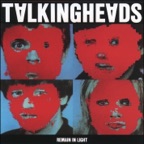
From Remain in Light, the most African and experimental of the three Talking Heads albums Eno produced, built from interlocking grooves. Eno and the band heard the same rhythm differently: for him the first beat of the bar was the empty one, for them it came later, like a normal pop song. There was tension off the record too, and it was the last album he made with them. Listen for the groove that never quite settles where you expect it.
“I was hearing the 'one' on the first beat, which is empty. They were hearing it on the third beat, like a normal pop song.”
— Brian Eno · Independent on Sunday, via Hyperreal, 1992 
Eno's third album with U2, and the song where the band traded sincerity for irony. By then he mostly came in as a consultant, flying in to play back the tapes and comment, but the sound is his: every part fuzzed, distorted or compressed. It was the first British number one of his career. Listen for the drums, which he said sound like someone bashing on the bars of a prison.
“Everything in that song is distorted in some way, fuzzed or compressed. So it sounds weird and murky and dangerous.”
— Brian Eno · Independent on Sunday, via Hyperreal, 1992

Lesson four: the voice as one more sound (1975–2022)
A Figure in the Landscape
Eno loves to sing but says he has nothing to say in songs, so he treats a voice the way a painter treats a person in a landscape: put even a tiny figure in a picture and the eye keeps going back to it. He decides how big the voice should be and where it sits, writes words for their sound as much as their meaning, and sings in character, because listeners always hear a voice as the singer's confession. These four songs span almost fifty years: two quiet songs from the 1970s, a lyric built from a bell-ringing pattern, and a late song where he finally lets his own older voice step forward. Listen for how much space the voice leaves around it.
“So for me, it was like I've been doing landscapes for a long time and now I have reintroduced some figures; i.e., the voice.”
Another Green World has fourteen pieces and only five with singing, yet everyone remembers it as a song record, which is what Eno wanted, because people listen harder to songs. Golden Hours is one of the five, a gentle song about time slipping away, with Robert Fripp on guitar. Listen for how short the sung parts are compared with the music around them.
“I learned this when I made Another Green World [1975], which had fourteen pieces on it, five of them vocal pieces.”
— Brian Eno · Mix, via More Dark Than Shark, 2005 
The best-loved song on Before and After Science, written with Hans-Joachim Roedelius and Dieter Moebius of the German duo Cluster. It is almost nothing: a slow electric piano figure and Eno's plain, close voice. Listen for how little he sings; the voice is a small figure, and the piano is the landscape.
“A voice is very exposing, and of course, a voice is always seen as being the voice of the creator, no matter how many times you tell them it isn’t.”
— Brian Eno · Pitchfork, 2017 From Nerve Net, his first solo album in seven years. The words were written for their sound: the order of the four rhyming sounds follows a bell-ringing pattern called Bob Doubles, spoken calmly over a slow electronic beat. After half a minute the song stops being a song and becomes a long instrumental that builds and fades. Listen for the lines that almost mean something.
“I like to write words that are on the border between meaning and nonsense, so you're not quite sure whether they mean anything or not.”
— Brian Eno · Independent on Sunday, via Hyperreal, 1992 
From FOREVERANDEVERNOMORE, a late album built mostly around his voice, which he performed live at the Barbican in London in 2022. After decades of hiding or disguising his singing, here it is low, plain and close, over slow, glowing synthesisers. He still knows listeners will take any voice as a confession. Listen for how the words sit inside the sound rather than on top of it.
“Even if you try to abstract your voice wildly, people still think: Hm, that Brian—doesn’t sound too happy.”
— Brian Eno · Pitchfork, 2017

Keep listening
 Read the story
David Bowie: how to try everything
The singer who took him to Berlin for Low, "Heroes" and Lodger, and the rest of the career around those three albums.
 Read the story
Robert Fripp: the man who met King Crimson
The guitarist on Baby's on Fire, St. Elmo's Fire and "Heroes", and his partner on the tape-loop records that led to ambient music.
Sources
This story was researched from these interviews, videos and references. Every quote is Brian Eno's own words, taken verbatim from the source marked “Quoted”.
Narration is an AI-generated voice (ElevenLabs), reading the text on this page.
Interviews
- A Conversation With Brian Eno About Ambient Music
Pitchfork, 2017Quoted
- Art scientific – a world exclusive interview with Brian Eno
Loud And Quiet, 2016Quoted
- Brian Eno, in conversation with Laurie Anderson, on Lux
Interview Magazine, 2013Quoted
- New Again: Brian Eno (Glenn O'Brien's interview from June 1978)
Interview Magazine, 1978Quoted
- Brian Eno on the recording of Another Day on Earth
Mix, via More Dark Than Shark, 2005Quoted
- Sound and Vision
Independent on Sunday, via Hyperreal, 1992Quoted
- Classic Brian Eno interview reveals how he really produced ambient music
MusicRadar, 2023
- A Conversation with Brian Eno
The Current, 2009
Videos
Reference
- Brian Eno: interviews, articles and reviews
Rock's Backpages
- Brian Eno
Wikipedia
Photos
- Brian Eno in dark-rimmed glasses and a black shirt during a 2015 interview
How We Get To Next · CC BY 3.0, via Wikimedia Commons
- Brian Eno in 1974 on Dutch television, in eye make-up, a beret and a patterned black jacket, in black and white
AVRO · CC BY-SA 3.0 nl, via Wikimedia Commons
- Brian Eno at a laptop and mixing desk during a live remix at the Punkt festival in 2012, in black and white
Joerundfp · CC BY 2.0, via Wikimedia Commons
- David Byrne and Brian Eno in a black and white Sire Records publicity photo, 1981
Distributed by Sire Records · Public domain, via Wikimedia Commons
- Brian Eno, small on a dark stage at a laptop, at the Barbican in London in 2022
Raph_PH · CC BY 2.0, via Wikimedia Commons